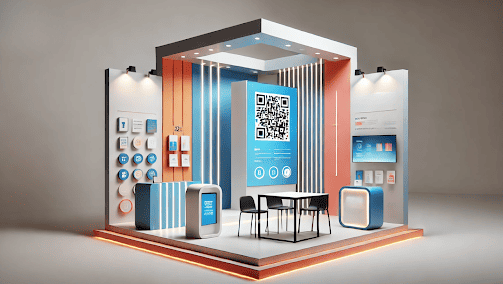
Footprint and impact are different variables
Booth impact is often treated as a function of physical size. In practice, participation depends on visibility, clarity and flow. A small activation with a one-sentence promise can be easier to understand than a large environment with several competing messages.
Examples include AI portraits, iris photography, palm reading concepts and date-based personalized prints. Each converts a short interaction into a defined output. The value proposition should be visible from the aisle: what the guest does, how long it takes and what the guest receives.
Design around the queue
A compact station still needs space for three zones: invitation, participation and delivery. If all three occur in the same spot, finished guests collide with incoming guests. Even an 8 by 8 or 10 by 10 foot plan can work when the entrance, camera position and exit are deliberately arranged.
Throughput should be expressed as completed groups or guests per hour, not vague claims such as fast or high volume. Interactive Dallas reports 50 to 70 groups per hour as a typical AI Photo Booth operating range, with results varying by prompt choice, group size and delivery method.
See also: What the Research Actually Says About Traditional Sauna Benefits, on a Budget
Choose a takeaway with perceived value
The most effective small-footprint formats produce something specific to the participant: a transformed portrait, a photographed iris, a personalized reading or a historical page tied to a birth date. Personal relevance gives the attendee a reason to keep the output after the show.
Build for trade show realities
- Confirm power, network access and local backup procedures.
- Use lighting that is controlled rather than dependent on convention-hall illumination.
- Place instructions where they can be understood before the guest reaches the front.
- Separate consent from marketing opt-in and avoid unnecessary data collection.
- Measure completed experiences, average cycle time, delivery rate and qualified conversations.
The decision rule
A small activation is a good fit when the experience can be explained in one sentence, completed predictably and operated without blocking the sales area. Trade show activations should support the exhibitor’s conversation strategy, not compete with it.
Frequently asked questions
What is a small-footprint activation?
It is an attendee experience designed to operate inside a limited booth area, often 8 by 8 or 10 by 10 feet, while producing a personalized result.
What matters more than footprint?
Guest flow, cycle time, visibility from the aisle and the perceived value of the takeaway.
Should delivery happen at the camera?
Not always. Moving digital delivery or print pickup to the exit side can reduce congestion.
