Introduction
Are you a project leader or an engineer tasked with procuring custom precision parts? I bet you are familiar with the “quotation black box.” You are provided with a single bottom-line price, while none of the cost factors are revealed to you. These cost factors are programming time, machine time, waste materials, and post-processing time. The absence of this information makes it impossible to compare quotes from different suppliers. Moreover, it can result in unexpected costs that cause your project budget to spiral out of control. The problem is that there is a lack of engineering transparency within traditional quotation models.
In other words, a vague quotation can result from inefficient process strategies, a lack of capability to handle complex geometries, or a lack of quality inspection cost strategies. In this article, a truly transparent 5-axis CNC machining quotation is deconstructed to provide a quotation evaluation framework.
What Are the Hidden Cost Drivers Behind a 5-Axis CNC Machining Service Quote?
The single price figure represents a myriad of variables. Recognizing these four fundamental engineering concepts is the initial step to de-mystifying your 5-axis CNC machining service quote and reaching cost estimation predictability.
- The Exponential Cost of Geometric Complexity: Design features such as deep cavities, thin walls, and extreme undercuts are costly. In 3-axis machining, this results in a myriad of setups and long-reach tools that cause machines to vibrate and produce poor finishes. Although 5-axis machines eliminate this problem, intricate free-form surfaces or intricate internal channels require intricate programming that is time-consuming. The programming time for a sculptured aerodynamically styled part is exponentially more expensive compared to a simple prismatic part.
- Material Machinability and Its Direct Impact: Material choice is a great contributor to expenses. To illustrate, a component made of a high-strength alloy Inconel versus another made of 6061 aluminum will certainly lead to large cost differences.Besides, if Inconel work-hardening is necessary, the expenses related to cutting speeds, tooling, and tools may see an increase by a factor of 200-300% each. Therefore, it is crucial that a detailed quote always indicates the grade and defends the cutting parameters by the unique problems of the grade.
- The Premium of Precision and Surface Finish: Tolerances and surface finish influence costs in a very straightforward way. Producing a poor part with a tolerance of 0. 01 mm instead of 0. 05 mm will demand a longer cutting time, better temperature control, and precision inspection with a CMM.Having a surface finish of a Ra 0. 4 m rather than the standard Ra 1. 6 m might call for some extra polishing or milling steps.
- Volume Economics Economics and Fixturing Strategy: The cost model changes dramatically from prototype to production. A one-off part will incur the full cost of CAM programming and fixture design. With production parts, the non-recurring engineering costs of programming and fixture design will be spread across the parts. A clear quote will break out the non-recurring costs from the per-part cost and describe the fixturing strategy — whether it is a modular system or a one-off fixture — because it is a significant and often non-disclosed cost factor.
3+2 Positioning vs. Continuous 5-Axis: Which Strategy Truly Optimizes Your Budget?
The selection of the most effective machining strategy is more important than the selection of the latest technology. To truly optimize your budget and successfully work with a 5-axis CNC manufacturer, it is essential to comprehend the difference between 3+2 positioning and continuous 5-axis machining.
1. The Principle of 3+2 Axis Machining
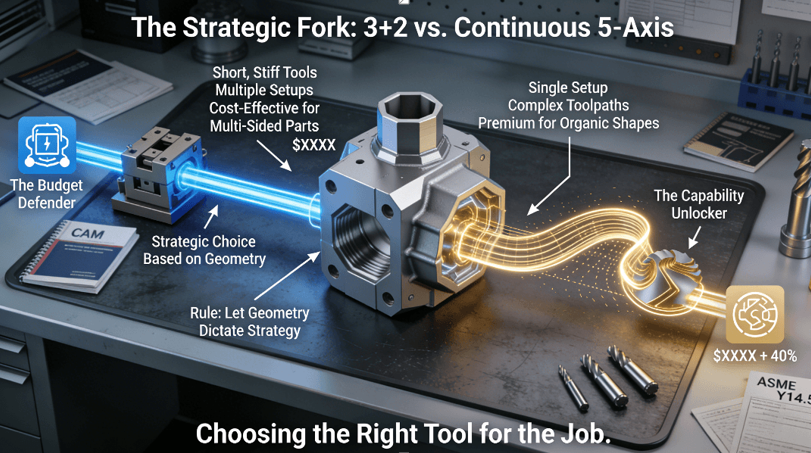
In 3+2 axis machining, also called positional 5-axis machining, the two axes are used to tilt the workpiece to an optimal fixed angle. After this, three-axis machining is used. This is particularly useful for workpieces such as multi-sided housings or valve body components that are characterized by complex features on various surfaces but not on curved surfaces. The major advantage is that shorter and stiffer tools are used to improve business efficiency without incurring the cost associated with simultaneous motion.
2. The Power and Cost of Continuous 5-Axis
Continuous or simultaneous 5-axis machining involves the dynamic movement of the five axes of the CNC simultaneously. This ensures that the tool is always correctly positioned relative to the complex and curved shapes of the workpiece. This method is effective in the machining of impellers, blades of turbines, and implants. However, it demands more sophisticated CAM programming, less speed due to precision requirements, and is more costly. This method is ideal for organic shapes and completely inappropriate for prismatic shapes.
3. Making the Strategic Choice for Cost Control
The budget-optimizing decision depends on the geometry of the part. A part that has features on multiple planes will always be more cost-effective and efficient if the strategy is 3+2. A supplier who is honest will always recommend the most efficient way of manufacturing the part, not the most advanced. To comprehend the full implications of the strategies on your CNC 5-axis machining service quote, it is important that an analysis of the part be conducted.
How Can Proactive Design Choices Slash Your Manufacturing Costs Before Production Even Begins?
The most substantial opportunities for cost reduction occur well before the machine begins to move. Proactive Design for Manufacturing (DFM) changes the design from being simply a geometric concept to an efficient manufacturing part, which is reflected in the CNC machining quote.
1. Standardizing Internal Radii and Corner Design
One of the simplest yet most impactful DFM guidelines is to standardize the internal radii of corners. Ensure that all internal pockets and vertical corners are designed to have a standard radius. The standard radius should be equal to that of your standard supplier’s end-mill cutter sizes. For example, it could be 3mm or 1/8″. If a part has a 4mm radius in one corner and a 5mm radius in another, it may require a different cutter or a less common cutter size. The result is a longer time to machine that part.
2. Rationalizing Depth-to-Width Ratios and Wall Thickness
If a part has a very narrow pocket that is deep or a very thin wall that is tall, it is a problem waiting to happen. These are difficult parts to machine as they require long-reach tools that are more prone to breakage. By making the walls thicker by 0.5mm or making a pocket less deep, it is possible to greatly extend tool life while improving accuracy and finish. These are some of the most important principles of designing for industrial solutions.
3. Applying Tolerances Based on Function, Not Defaults
The impact of tolerancing on costs is non-linear. It does not make sense to apply a ±0.05mm tolerance across the board on all features of a part. Instead, a functional tolerance analysis should be done. Critical features (bearing seats, seal surfaces) should have tight tolerancing; all others can have liberal tolerancing. A noncritical face might have a tolerance of ±0.2mm rather than ±0.05mm, eliminating a slow finishing operation. This methodical approach, based on documents like ASME Y14.5, is the hallmark of precision manufacturing intelligence.
See also: Transform Your Team’s Performance with Effective Manager Training Strategies
What Does a Genuinely Transparent and Trustworthy CNC Quote Breakdown Include?
A trustworthy CNC machine quote is a detailed offer, both technically and financially. It should enable you to understand the “reasons” behind every cost.
1. The Anatomy of a Transparent Cost Breakdown
A first-rate quote includes a detailed cost breakdown. This includes the cost of materials, including alloy, size, and current market rate, programming and engineering, including CAM programming and simulation hours, and machine time, including individual operations, such as “5 axis roughing – 4.5 hours” and “3+2 finishing – 2.0 hours.” It also includes special tooling and fixturing, including if it’s a reusable modular fixture, and all post-processing and quality inspection, including anodizing and/or CMM inspection, including callouts on all critical dimensions.
2. The Critical Role of Inspection and Quality Assurance
The inspection methodology should never be an afterthought. A first-rate quote includes information on how quality assurance will be performed, including if there will be a first article inspection report, and if so, what equipment will be utilized, including CMM and/or optical comparators. What standards will be met? This requires that our supplier has an excellent quality management system in place. For regulated industries, this goes beyond an entry-level ISO 9001 framework and includes standards like IATF 16949, required in the automotive industry, and AS9100D, required in the aerospace industry, including full traceability and process control, making it worth every penny.
3. Assumptions, Exclusions, and the Path Forward
Another aspect of transparency is clearly defining what is excluded from the scope of the project. A professional quote will clearly define the assumptions made during the creation of the quote, such as “quote based on provided STEP model, revision B,” and the standard exclusions, such as “does not include international shipping duties.” Most importantly, it will clearly define the steps that will be taken, such as a formal design review of the manufacturing quote and process plan, before any work is started, to ensure full alignment.
How to Perform an ‘Apples-to-Apples’ Comparison When Evaluating Multiple Supplier Bids?
With the transparent and detailed quotes in hand, the last step is a controlled audit-type comparison, where the discussion shifts from price to value and risk, a fundamental concept of successful supply chain optimization.
1. Deconstructing and Aligning the Scope of Work
Build a comparison matrix. Align each supplier’s quote with your original RFQ requirements. Make sure material specifications are exactly the same (same material, same standard). Check to ensure that quoted machine time per operation is similar. Large variances in machine time per operation may indicate different machining strategies or experience levels. Be sure that scope is similar for post-processing and inspection. A lower price without hardening or inspection is an illusion.
2. Interrogating the ‘Why’ Behind the Numbers
Go deeper than just hours and dollars. What was the logic or reasoning for one supplier’s quoted time over another? For example, did one supplier recognize a more efficient 3+2 strategy for your part, whereas another supplier used a continuous 5-axis strategy? Does one supplier’s quoted price include a detailed description of tooling or fixturing strategy? A supplier who does this is showing you expertise in precision 5-axis machining services and is likely a more reliable supplier because they are considering your part’s manufacturability, not just your project’s price.
3. Assessing Risk Through Terms, Capacity, and Communication
Lastly, we need to consider the intangible factors that will ultimately drive project risk. Reviewing the terms and conditions related to change order policies is important. Also, we must consider the capacity realism of the supplier. Most importantly, we must consider the quality of communication during the quoting process. A supplier that asks clarifying questions and offers DFM suggestions is a supplier that is invested in your project’s success and is willing to help you avoid costly mistakes down the line.
Can a Medical Device Case Study Demonstrate the Tangible Value of Pricing Transparency?
Let’s consider a real-world scenario. A medical device startup had a project that required a prototype run of a titanium spinal implant fixture. The device had a complex geometry that had organic curves and critical surfaces that had to interface with bone. They had received quotes from a few different sources that came back at $2,800, $4,100, and $5,500. The range is staggering.
1. The Problem: Incomparable Quotes and Hidden Assumptions
The lowest quote was just one short line item: “5-axis machining – $2,800. ” The highest quote went a little further and said: “Full continuous 5-axis required for optimal quality. ” In addition, none of the vendors explained their logic, nor did they give a breakdown of the assumptions they had been making. So, the team could not figure out if the lower price was a steal or future trouble. On the other hand, they could not decide if the higher price was a solution that was over-engineered.
2. The Solution: Transparent, Strategy-Based Options
The transparent supplier provided two options. Plan A employed a hybrid solution. It utilized 3+2 positioning for all features except the critical surfaces. For those surfaces, the supplier chose continuous 5-axis. A breakdown of the costs was provided. This option promised a 30% time saving. Plan B employed continuous 5-axis. It showed a slightly better finish on the non-critical surfaces at a 40% premium.
3. The Outcome: Empowered Decision-Making and Budget Control
With completely open and direct comparisons before them, their decision was very clear. As Plan A fulfilled the entire set of criteria and was much cheaper, the medical team decided to go with it. The quote was more or less the overall project plan or guide. The project was completed not only on time but also within the budget. They did not encounter anything unexpected.
Conclusion
While obtaining a fully transparent 5-axis CNC machining quote is certainly more involved than simply receiving a detailed price list, it is in fact a fundamental change in mindset. This change in mindset converts the buyer from a passive recipient of prices to an active value manager based on an understanding of the underlying engineering principles. This starts with a strong understanding of your part’s geometry and material, is greatly aided by design-stage collaboration (DFM), and is ultimately achieved through a detailed and auditable cost breakdown. In today’s competitive manufacturing environment, such a high degree of budget transparency and process transparency is a non-negotiable requirement for building long-term trust, success, and financial security.
FAQs
Q: How long does it usually take to get a fully detailed quote for a complex 5-axis part?
A: For a detailed and transparent quote, a thorough engineering analysis is necessary. Honest suppliers normally give an itemized quote within 24 to 48 hours for pieces of average complexity. When it comes to parts with very complex shapes that require advanced simulation, a little extra time might be needed. The main thing is to get a quote that lists the time for each operation, the reason for the choice of material, and the post-processing expenses, not just one lump sum.
Q: Is the lowest quote always the best value? A: It is not always the case. A significantly low quote is actually a major warning sign.
It may be hinting that the machining time has been underestimated; process steps that are needed have been left out (e. g. proper inspection or heat treatment); usage of lesser quality materials; or inexperience with a particular geometry. In fact, value lies in a quote that weighs the costs against the technical rationale, the solid quality plans, and a dependable production timeline.
Q: What should I do if the quotes I receive vary dramatically in price?
A: Large price differences should immediately raise red flags. Treat the difference as a guide for further investigation. Contact the vendors again and ask for a detailed explanation of their price components, based on the format discussed in this article. Usually, differences in price are due to variations in the chosen machining strategy, the level of work involved (e.g. is inspection included or not), or the source of the material.
Q: How can I be sure the supplier can actually achieve the tolerances stated in their quote?
A: A quote should, by itself, serve as evidence of the supplier’s ability. Check if the supplier states the precision of the machine tool (e. g. machine positioning repeatability), the inspection technique they will employ (e. g. “First Article Inspection by CMM”), and quality certificates relevant to your sector such as ISO 9001 or AS9100D. A reliable supplier would not propose a tolerance level that they cannot continually measure and manufacture.
Q: Are costs for design-for-manufacturability (DFM) feedback included in a quote?
A: Ideally, initial DFM review should be part of the standard offering during quoting and no extra charge should be made for this. This joint effort helps to find cheaper solutions before the design is locked and manufacture is started. A supplier wanting a good partnership will give you this feedback without being asked.
Author Bio
The ideas shared in this paper stem from the authors deep first-hand acquaintance with precision manufacturing and supply chain collaboration. Together with the author, the team strives to convert intricate designs into superb, manufacturable components through engineering partnership and complete transparency. Their quality management system which supports them in achieving these goals is compliant with international standards such as ISO 9001, IATF 16949, and AS9100D. LS Manufacturing offers professional DFM advice and a detailed, cost breakdown-based quotation to help you achieve success at all stages of your project, from the first quote to final delivery.